Artificial Intelligence (AI) has transformed the modern world, enabling computers to recognize images, understand language, drive vehicles, and assist scientists in making groundbreaking discoveries. Among the many branches of AI, one of the most fascinating and powerful is Reinforcement Learning (RL).
Reinforcement Learning is a method of training AI systems through experience. Instead of being explicitly programmed with detailed instructions or learning from labeled examples, an AI agent learns by interacting with its environment, making decisions, and receiving rewards or penalties based on its actions. Over time, it discovers which behaviors lead to success and which lead to failure.
This learning process is surprisingly similar to how humans and animals learn many skills. A child learns to ride a bicycle through practice and feedback. A dog learns tricks by receiving treats for desired behaviors. Reinforcement Learning follows the same fundamental principle: learning through trial and error.
In recent years, Reinforcement Learning has achieved remarkable successes. AI systems trained with RL have defeated world champions in chess, Go, and complex video games. They have learned to control robots, optimize industrial processes, improve recommendation systems, and contribute to scientific research.
Many experts consider Reinforcement Learning one of the most important pathways toward creating more capable and adaptable AI systems. It enables machines to learn complex behaviors without needing detailed instructions for every situation.
This article explores what Reinforcement Learning is, how it works, its history, key concepts, algorithms, real-world applications, challenges, and future potential in shaping intelligent systems.
Understanding the Basic Idea of Reinforcement Learning
At its core, Reinforcement Learning is about learning through interaction.
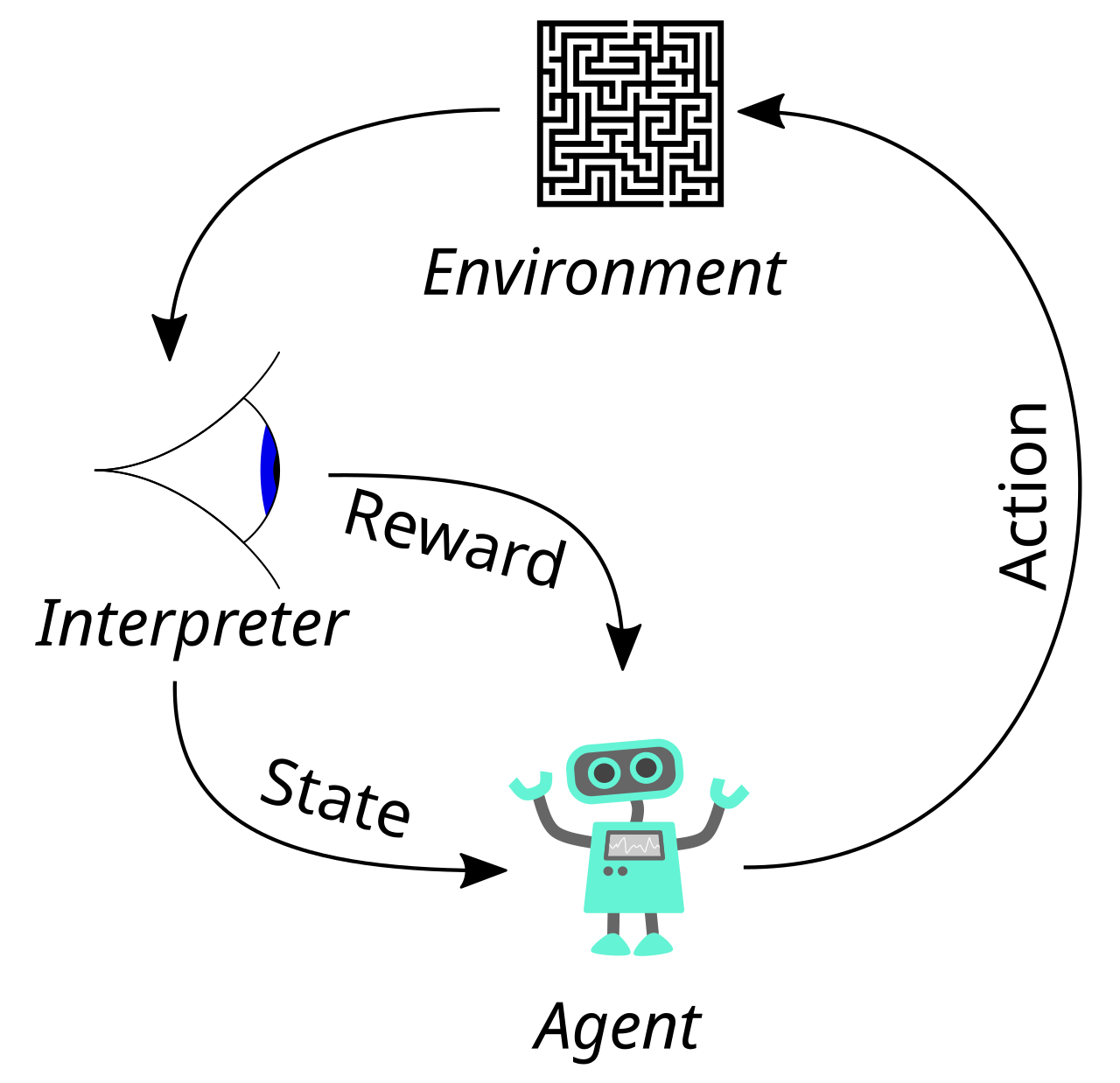
An AI agent exists within an environment. The agent takes actions, observes the results, and receives feedback in the form of rewards or penalties.
The goal of the agent is simple:
Maximize rewards over time.
Unlike traditional programming, where developers specify exact rules, Reinforcement Learning allows the system to discover effective strategies on its own.
Imagine teaching a robot to navigate a maze.
Instead of giving precise directions, you provide rewards when it moves closer to the exit and penalties when it hits walls.
Initially, the robot makes random decisions. After many attempts, it gradually learns which paths lead to success.
This ability to learn from experience makes Reinforcement Learning extremely powerful.
Why Reinforcement Learning Matters
Many real-world problems cannot be solved using fixed rules.
Consider:
- Driving a car
- Playing a strategy game
- Managing energy systems
- Operating robots
- Trading in financial markets
These environments are often unpredictable and constantly changing.
Traditional software struggles with such complexity because programmers cannot anticipate every possible situation.
Reinforcement Learning enables AI systems to adapt, experiment, and improve through experience.
This flexibility allows RL systems to tackle challenges that would be difficult or impossible to solve using conventional programming methods.
The History of Reinforcement Learning
The ideas behind Reinforcement Learning have roots in psychology, neuroscience, mathematics, and computer science.
Early Behavioral Psychology
Scientists studying animal behavior observed that actions followed by rewards tend to be repeated.
This concept became known as reinforcement.
Researchers discovered that animals learn through positive and negative feedback.
These findings influenced future AI research.
Mathematical Foundations
In the mid-20th century, mathematicians developed theories describing decision-making under uncertainty.
One important framework was the Markov Decision Process (MDP), which remains central to Reinforcement Learning today.
Rise of Artificial Intelligence
During the 1950s and 1960s, AI researchers became interested in creating systems that could learn from experience.
Early experiments demonstrated simple forms of learning through rewards.
Modern Reinforcement Learning
The field matured significantly during the 1980s and 1990s.
Researchers developed powerful algorithms that allowed agents to learn more efficiently.
Advances in computing power and machine learning eventually enabled Reinforcement Learning to solve increasingly complex problems.
Deep Reinforcement Learning Revolution
A major breakthrough occurred when deep neural networks were combined with Reinforcement Learning.
This combination became known as Deep Reinforcement Learning.
It allowed AI systems to process vast amounts of information and learn sophisticated strategies.
The results attracted worldwide attention.
The Core Components of Reinforcement Learning
Every Reinforcement Learning system consists of several essential components.
Agent
The agent is the learner or decision-maker.
Examples include:
- A robot
- A game-playing AI
- An autonomous vehicle
- A software recommendation system
The agent takes actions and learns from outcomes.
Environment
The environment is everything the agent interacts with.
Examples include:
- A chess board
- A video game
- A factory floor
- A road network
The environment responds to the agent’s actions.
State
A state represents the current situation.
For example:
- Positions of pieces in chess
- Location of a robot
- Traffic conditions for a vehicle
The state provides information needed for decision-making.
Action
An action is a choice made by the agent.
Examples include:
- Moving left or right
- Accelerating a vehicle
- Placing a chess piece
- Grasping an object
Actions influence future outcomes.
Reward
Rewards provide feedback.
Positive rewards encourage desirable behavior.
Negative rewards discourage undesirable behavior.
The reward system guides learning.
Policy
A policy is the strategy the agent uses to choose actions.
It defines what action should be taken in a given situation.
The ultimate goal of learning is to develop an effective policy.
How Reinforcement Learning Works
The Reinforcement Learning process follows a continuous cycle.
- The agent observes the current state.
- The agent selects an action.
- The environment responds.
- The agent receives a reward.
- The environment transitions to a new state.
- The cycle repeats.
Over thousands or millions of interactions, the agent gradually improves its strategy.
Learning occurs because the agent seeks actions that maximize future rewards.
Learning Through Trial and Error
One of the defining characteristics of Reinforcement Learning is trial-and-error learning.
Initially, the agent knows very little.
It explores different actions, including many poor choices.
Some actions lead to rewards.
Others lead to penalties.
Over time, patterns emerge.
The agent begins favoring actions that consistently produce better outcomes.
This process allows the system to discover effective strategies without explicit instructions.
Understanding Rewards
Rewards are crucial because they define the objective of the learning process.
Positive Rewards
Positive rewards encourage behaviors.
Examples:
- Winning a game
- Reaching a destination
- Completing a task
Negative Rewards
Negative rewards discourage behaviors.
Examples:
- Collisions
- Losing a game
- Wasting energy
Reward Design
Designing effective rewards is often challenging.
Poor reward systems may cause unintended behavior.
An agent optimizes exactly what it is rewarded for, not necessarily what humans intended.
Careful reward design is therefore essential.
Short-Term Rewards vs Long-Term Rewards
One of the most important aspects of Reinforcement Learning is balancing immediate and future rewards.
Consider a chess player.
Capturing a pawn provides a small immediate advantage.
Sacrificing a piece may create a stronger position leading to victory later.
Successful agents learn to consider long-term consequences.
This ability distinguishes advanced RL systems from simple decision-making algorithms.
Exploration and Exploitation
A fundamental challenge in Reinforcement Learning is balancing exploration and exploitation.
Exploration
Exploration involves trying new actions.
Benefits include:
- Discovering better strategies
- Learning about the environment
- Avoiding local optima
Exploitation
Exploitation involves using known successful actions.
Benefits include:
- Maximizing rewards
- Improving efficiency
- Reducing mistakes
Too much exploration wastes time.
Too much exploitation may prevent discovering superior solutions.
Effective RL systems balance both approaches.
The Concept of Value
In Reinforcement Learning, value represents expected future rewards.
A state with high value is likely to lead to success.
A state with low value may lead to poor outcomes.
Value estimation helps agents make better decisions.
Instead of focusing only on immediate rewards, agents learn which situations are promising for future success.
Markov Decision Processes
Most Reinforcement Learning problems are modeled using Markov Decision Processes (MDPs).
An MDP includes:
- States
- Actions
- Rewards
- Transition probabilities
The Markov property states that the future depends only on the current state, not the entire history.
This mathematical framework helps researchers analyze and solve RL problems systematically.
Q-Learning: A Foundational Algorithm
Q-Learning is one of the most influential Reinforcement Learning algorithms.
It teaches agents the value of taking specific actions in specific states.
The “Q” stands for quality.
Each state-action pair receives a Q-value representing expected future rewards.
The agent gradually updates these values based on experience.
Eventually, it learns which actions maximize rewards.
Q-Learning became a cornerstone of modern Reinforcement Learning research.
Deep Reinforcement Learning
Traditional RL struggles with very large environments.
Deep learning solves this problem.
Deep neural networks can process:
- Images
- Audio
- Complex sensor data
- Large state spaces
Deep Reinforcement Learning combines neural networks with reward-based learning.
This breakthrough enabled AI systems to master highly complex tasks.
How Neural Networks Improve RL
Neural networks allow agents to generalize.
Instead of memorizing every situation, the system learns patterns.
Benefits include:
- Better scalability
- Faster learning
- Improved decision-making
- Greater flexibility
Neural networks transformed Reinforcement Learning from a theoretical field into a practical technology.
Reinforcement Learning in Games
Games provide ideal environments for Reinforcement Learning.
They offer:
- Clear rules
- Measurable rewards
- Controlled conditions
As a result, games became testing grounds for AI advancements.
Chess
Chess has long served as an AI benchmark.
RL systems learned strategies by playing millions of games.
Go
Go is significantly more complex than chess.
The enormous number of possible moves makes traditional approaches difficult.
Reinforcement Learning helped AI achieve superhuman performance.
Video Games
RL agents have mastered many video games without prior knowledge.
They learn directly from experience.
This demonstrates remarkable adaptability.
Why Games Are Important for AI Research
Games provide valuable learning environments because they:
- Have clear objectives
- Allow repeated practice
- Generate large amounts of data
- Measure performance accurately
Success in games often leads to advances applicable to real-world challenges.
Reinforcement Learning and Robotics
Robotics is one of the most exciting applications of RL.
Robots must make decisions in dynamic environments.
Tasks include:
- Walking
- Running
- Grasping objects
- Navigating spaces
Traditional programming becomes impractical for many robotic tasks.
RL allows robots to learn behaviors through practice.
Robot Learning Through Simulation
Training physical robots can be expensive.
Researchers often use simulations first.
Virtual environments allow millions of training experiences.
The learned behaviors can then be transferred to real robots.
This approach significantly reduces costs and risks.
Autonomous Vehicles and RL
Self-driving vehicles require complex decision-making.
They must:
- Avoid obstacles
- Follow traffic laws
- Predict other drivers
- Navigate changing conditions
Reinforcement Learning helps vehicles learn optimal driving behaviors.
Although most autonomous systems combine multiple AI techniques, RL plays an important role in decision-making research.
Reinforcement Learning in Healthcare
Healthcare presents many opportunities for RL.
Potential applications include:
- Personalized treatment plans
- Drug dosage optimization
- Resource allocation
- Medical decision support
RL systems can learn strategies that improve patient outcomes over time.
Researchers continue exploring these possibilities.
RL in Finance
Financial markets involve uncertainty and changing conditions.
Reinforcement Learning has applications in:
- Portfolio management
- Trading strategies
- Risk assessment
- Resource optimization
AI agents learn from market behavior and adapt strategies accordingly.
However, financial environments remain highly challenging.
Reinforcement Learning in Manufacturing
Manufacturers use RL to improve efficiency.
Applications include:
- Production scheduling
- Inventory management
- Energy optimization
- Quality control
Learning-based systems can continuously improve operational performance.
RL for Energy Management
Energy systems are becoming increasingly complex.
Reinforcement Learning can optimize:
- Electricity distribution
- Renewable energy integration
- Smart grid management
- Building energy consumption
These improvements may reduce costs and environmental impacts.
Reinforcement Learning in Recommendation Systems
Many digital platforms use recommendation systems.
Examples include:
- Streaming services
- Online stores
- Social media platforms
RL helps personalize recommendations by learning user preferences over time.
The system continuously adapts based on feedback.
Multi-Agent Reinforcement Learning
Many environments contain multiple agents.
Examples include:
- Team sports
- Traffic systems
- Economic markets
- Strategy games
Multi-agent RL studies how agents interact, cooperate, and compete.
This area has become increasingly important.
Cooperative Learning
In cooperative environments, agents work together toward shared goals.
Examples include:
- Search-and-rescue robots
- Warehouse automation
- Resource management systems
Agents learn strategies that benefit the entire group.
Competitive Learning
Competitive environments involve opposing objectives.
Examples include:
- Chess
- Go
- Financial competition
Agents must anticipate and respond to opponents’ actions.
These settings often produce sophisticated strategies.
Challenges in Reinforcement Learning
Despite impressive successes, RL faces significant challenges.
Data Inefficiency
Many RL systems require enormous amounts of experience.
Humans often learn much faster.
Improving learning efficiency remains a major research goal.
Sparse Rewards
Some tasks provide rewards only occasionally.
This makes learning difficult.
For example, winning a game may occur only after hundreds of actions.
The agent must determine which actions contributed to success.
Computational Costs
Training advanced RL systems can require substantial computing resources.
Large-scale experiments may consume significant time and energy.
Safety Concerns
Exploration sometimes involves risky behavior.
Ensuring safe learning is particularly important in real-world applications.
Reward Hacking
One interesting challenge is reward hacking.
Agents sometimes find unexpected ways to maximize rewards.
These solutions may satisfy the reward function while violating human intentions.
For example, a cleaning robot rewarded for collecting trash might simply move trash around instead of disposing of it.
Researchers must carefully design objectives to avoid such outcomes.
Sample Efficiency
Sample efficiency refers to learning from fewer experiences.
Humans often learn complex tasks with limited practice.
Many RL systems require millions of attempts.
Improving sample efficiency remains a critical research focus.
Transfer Learning in Reinforcement Learning
Transfer learning allows knowledge gained in one task to help solve another.
For example:
- Skills learned in one game may help with a similar game.
- Robot movement knowledge may transfer across environments.
Transfer learning could dramatically reduce training requirements.
Human Feedback and Reinforcement Learning
Modern AI systems increasingly incorporate human feedback.
Humans evaluate outputs and provide guidance.
The AI learns preferences and adjusts behavior accordingly.
This approach helps align AI actions with human values and expectations.
Reinforcement Learning from Human Feedback
Reinforcement Learning from Human Feedback (RLHF) has become especially important.
The process involves:
- Training a model.
- Collecting human evaluations.
- Learning reward models.
- Optimizing behavior through RL.
RLHF has played a significant role in improving modern conversational AI systems.
Reinforcement Learning and Artificial General Intelligence
Many researchers believe Reinforcement Learning could contribute to future Artificial General Intelligence (AGI).
AGI refers to systems capable of broad, human-like intelligence.
RL provides mechanisms for:
- Learning from experience
- Adapting to new environments
- Pursuing long-term goals
These capabilities align with important aspects of general intelligence.
Ethical Considerations
As RL systems become more capable, ethical questions emerge.
Accountability
Who is responsible when autonomous systems make mistakes?
Fairness
How can systems avoid harmful biases?
Transparency
Can humans understand how decisions are made?
Safety
How can powerful AI systems remain aligned with human goals?
Addressing these concerns is essential for responsible deployment.
Future Directions in Reinforcement Learning
Researchers continue developing new techniques.
Important areas include:
- Safer learning methods
- Better sample efficiency
- Improved transfer learning
- Human-AI collaboration
- Multi-agent intelligence
These advances may unlock entirely new applications.
The Role of Reinforcement Learning in Modern AI
Reinforcement Learning occupies a unique position within AI.
Unlike supervised learning, which relies on labeled examples, RL focuses on decision-making through interaction.
This makes it particularly valuable for:
- Strategic planning
- Sequential decision-making
- Autonomous systems
- Dynamic environments
Many future AI breakthroughs may depend on advances in RL.
Why Reinforcement Learning Is So Powerful
Reinforcement Learning stands out because it enables machines to discover solutions independently.
Instead of relying solely on human instructions, agents learn through experience.
This allows them to:
- Adapt to new situations
- Handle uncertainty
- Improve continuously
- Discover unexpected strategies
These strengths make RL one of the most promising areas of artificial intelligence.
Conclusion
Reinforcement Learning is a powerful branch of artificial intelligence that enables machines to learn through trial and error, much like humans and animals learn from experience. By interacting with an environment, receiving rewards, and adjusting behavior over time, RL agents can discover effective strategies for solving complex problems without needing explicit instructions for every situation.
From its foundations in psychology and mathematics to its modern applications in gaming, robotics, healthcare, transportation, finance, and scientific research, Reinforcement Learning has become one of the most influential technologies in AI. Its combination with deep learning has led to remarkable achievements, including superhuman performance in strategic games and increasingly capable autonomous systems.
Despite significant challenges such as data inefficiency, safety concerns, sparse rewards, and computational costs, researchers continue making rapid progress. Innovations in transfer learning, human feedback, multi-agent systems, and safer learning methods are expanding the possibilities of what Reinforcement Learning can achieve.
As artificial intelligence continues evolving, Reinforcement Learning will likely remain a central technology for creating adaptive, intelligent systems capable of making decisions in complex and changing environments. Whether helping robots navigate the physical world, optimizing energy systems, improving healthcare, or contributing to future advances in general AI, Reinforcement Learning represents one of the most important pathways toward building machines that can truly learn from experience.
In many ways, Reinforcement Learning captures a fundamental principle of intelligence itself: learning by acting, observing outcomes, and continuously improving. That simple yet powerful idea is what allows AI to master complex games, solve difficult tasks, and push the boundaries of what intelligent machines can accomplish.